


By TotallyRandie
BPUSA Social Media Correspondent
On Tuesday, May 26, 2026, Rep. Christian D. Menefee defeated Congressman Al Green in the Democratic primary runoff for Texas’ newly drawn 18th Congressional District.
The defeat of Congressman Al Green isn’t as simple or, better yet, as clean as it seems.
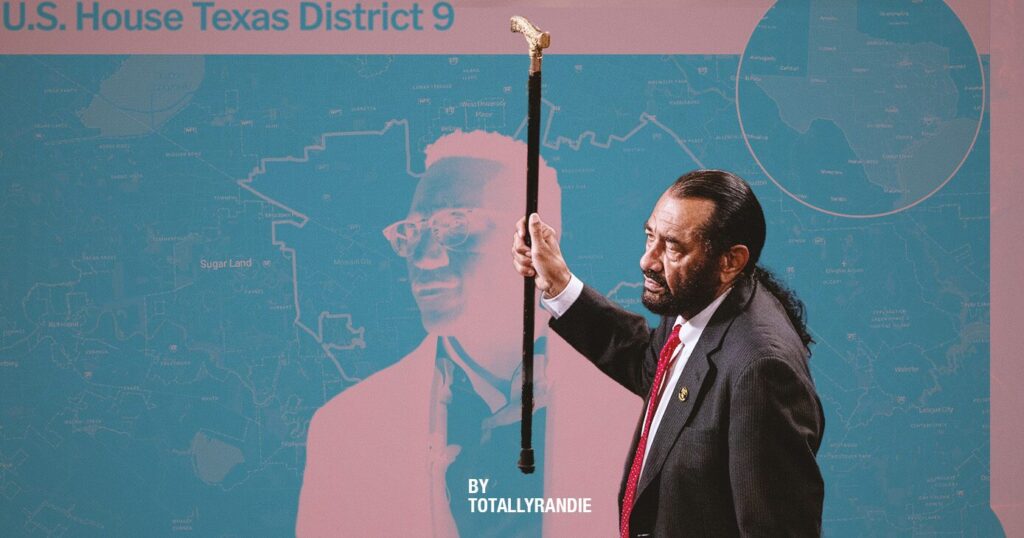
Republican lawmakers redrew the map, stripping away most of the historic, diverse base of his 9th Congressional District, which he had served since 2005. Green was forced into a newly configured 18th District, where he faced another Black incumbent.
So, yes, Menefee won the race. But calling it a clean generational handoff or a political upset would be dishonest. Green was not defeated in a district of his own choosing. The race was tainted before voters got to the polls.
How the Map Was Drawn
During a mid-decade redistricting push last summer, the Republican-controlled Texas Legislature shifted the 9th District’s boundaries into a red-leaning layout in east Harris County. The new lines pulled Green’s core voters out from under him and dumped them into the 18th, where Menefee was already the sitting congressman after winning a January 2026 special election.
That left Green with two options: retire or run against a fellow Democrat in a district that was no longer his.
This gerrymandering play is the standard. You compress historic urban coalitions into fewer districts, or you force trusted minority leaders to fight each other for one seat. Either way, the communities that built political power over decades lose it.
And what worked in Texas won’t stay in Texas. We are seeing the same playbook already in Mississippi, Alabama, Tennessee, Georgia, and South Carolina. Texas was the proof of concept. Republican lawmakers are testing how far they can go in redrawing minority political power out of existence.
What was Built in Twenty Years
Green’s record in Congress matched the work he did before he was elected. He was a Harris County Justice of the Peace for 26 years and led the Houston NAACP for about a decade, expanding its membership from a few hundred to thousands.
In Washington, he sat on the House Financial Services Committee, focusing on fair housing and fair lending. He pushed to strengthen the Community Reinvestment Act to stop banks from redlining Black and brown neighborhoods. He directed federal dollars into affordable housing in Houston to prevent the displacement of working-class families.
After Hurricane Harvey and the floods that followed, Green used his seniority to direct federal relief to historically neglected neighborhoods that were always last in line for disaster funds. He also brought federal funding to community health centers serving uninsured and underinsured residents across Houston.
Green was also the first member of Congress to introduce articles of impeachment against Donald Trump. That got the national attention. But it was never the core of his work.
Civil Rights Was his Job
Rep. Al Green co-sponsored legislation to restore the full protections of the Voting Rights Act. He pressed for federal accountability on police misconduct and hate crimes. He was censured by the House for disrupting a Trump address to Congress.
In February 2026, Green was ejected from the State of the Union for the second year in a row. This time, he held up a sign reading “Black People Aren’t Apes!” as Trump entered the chamber. The sign was a response to a video Trump had posted on Truth Social depicting Barack and Michelle Obama as apes. Trump later deleted the video after bipartisan backlash.
“The genesis of this was the president of the United States portraying Michelle and Barack Obama as members of the primate family,” Green told reporters after being removed. “That is unacceptable. It’s racist. And we have to confront racism, even when it emanates from the highest office in the land.”
What Was Actually Lost
Some coverage will frame this as the end of an era, and in the narrowest sense, it is. Green, 78, lost to Menefee, 38, makes the generational narrative easy to follow.
But what actually changed hands was twenty years of accumulated seniority, committee relationships, and institutional knowledge built around one question that America keeps revisiting: how do you bring federal resources to Black and Brown communities that are historically overlooked?
The redistricting did not answer that question. It just stopped twenty years of progress in solving it.
But what Green built over twenty years is not gone. It is the blueprint for the seat Menefee now holds. Did the people who drew the lines understand that, or did they just not care?


