

By Stacy M. Brown
Washington was never supposed to remember these people.
That is the point.
A country that once made it illegal to teach enslaved Black people to read is now arguing over whether Black history itself belongs in classrooms. A Supreme Court that already weakened the Voting Rights Act has now delivered what civil rights groups describe as one of the most devastating blows to Black political representation in generations, triggering fresh battles over congressional maps, voting districts, and the future of Black political power across the South.
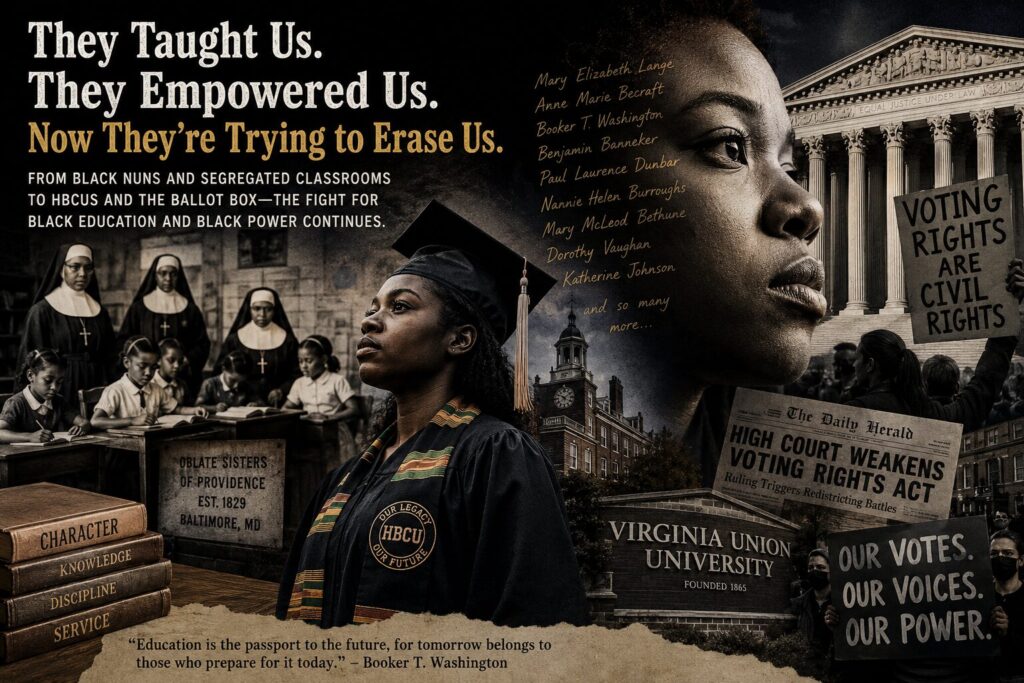
And yet, inside church archives, segregated classrooms, HBCU lecture halls, and fading family memories, another America survives. One built by Black nuns, Black teachers, Black colleges, and Black parents who understood long ago that education was never simply about opportunity.
It was protection. It was resistance. And eventually, it became political power.
“They are trying to erase the infrastructure that produced Black advancement,” said historian Dr. Elaine Porter, 84, a retired scholar of Black Catholic education in Northeast, D.C.
“People keep talking about voting rights without understanding the educational roots underneath political power,” Porter stated. “Educated Black communities became organized Black communities. Organized Black communities became voting blocs. That terrified segregationists then, and it terrifies people now.”
The roots of that story stretch back nearly 200 years.
In 1829, Mother Mary Elizabeth Lange and several other women of African descent established the Oblate Sisters of Providence, the first successful order of Black Catholic nuns in the United States. The sisters founded schools for Black children at a time when white institutions routinely excluded Black students and denied Black women entry into white religious orders.
Historical records show the Oblate Sisters operated educational missions throughout Baltimore and Washington while helping establish pathways for Black Catholic education during segregation. Anne Marie Becraft, one of the earliest Black educators in Washington, operated a school for Black girls in Georgetown before joining the order in 1831.
“They were teaching Black children while America was still debating whether Black people were fully human,” Porter said. “That is not ancient history. That is the foundation of modern Black political consciousness.”
The conversation that sparked this reporting moved between segregated Catholic schools, HBCUs, affirmative action, voting rights, and the growing fear among many Black Americans that the country is systematically dismantling the gains won during the civil rights era.
“They think these schools are inferior,” one source, with strong political ties, said during the discussion. “My question is, how did they get to Harvard, Yale, Princeton, and all those places in the old days?”
The answer sits in institutions many Americans barely know exist.
From Spelman College to Virginia Union University, from Black Catholic schools in Baltimore and Washington to rural segregated classrooms built during Reconstruction, Black educational institutions became engines of survival in a country built around Black exclusion.
The National Museum of African American History and Culture documents how formerly enslaved Black Americans pursued education immediately after emancipation, often building schools themselves despite violent opposition from white supremacists. During Reconstruction, Black churches became educational centers throughout the South. The National Park Service has documented how African Americans built schools such as the Tolson’s Chapel schools in Maryland because education represented freedom itself.
“They understood education differently because they had experienced life without it,” Porter said. “Black education was never treated casually in our communities. It was sacred.”
That history now collides with a political moment civil rights advocates describe as openly hostile toward Black voting strength and Black institutional power.
The NAACP called the Supreme Court’s recent Louisiana voting rights ruling “the death knell” for the nation’s most important federal civil rights law, warning the decision threatens to erase decades of progress protecting Black voters from racial discrimination.
“The Supreme Court betrayed Black voters, they betrayed America, and they betrayed our democracy,” the NAACP said in a statement following the ruling.
The ruling weakened Section 2 of the Voting Rights Act, a key legal tool used for decades to challenge racially discriminatory district maps. Civil rights organizations say the decision has already emboldened lawmakers in several Southern states to aggressively redraw congressional districts in ways that dilute Black voting power.
In Tennessee, Republicans moved quickly to dismantle the state’s only majority-Black congressional district centered in Memphis. The NAACP Tennessee State Conference filed an emergency lawsuit accusing the state of attempting to eliminate Black political representation.
“Gerrymandering and attacks on Black education come from the same place,” said voting rights advocate Marcus Ellison, 58, of Atlanta. “You cannot separate literacy from voting. You cannot separate educational access from political participation. The strategy has always been the same. Reduce Black organization. Reduce Black representation. Reduce Black influence.”
Civil rights leaders say the attacks now extend far beyond congressional maps.
Since the Supreme Court struck down race-conscious admissions in higher education, universities across the country have rolled back diversity initiatives while Black enrollment at several elite predominantly white institutions has declined sharply. At the same time, applications to HBCUs have surged. Howard University reportedly received more than 36,000 applications for fall 2024, while national HBCU enrollment climbed significantly after the affirmative action ruling.
“HBCUs became sanctuaries again,” said Virginia Union political science graduate Dr. Harold Greene, 63. “Students understood exactly what they were seeing. They saw the country retreating.”
Greene said many younger Black Americans now view attacks on DEI programs, voting rights, and Black studies as interconnected.
“The language changes,” Greene said. “First, it was segregation. Then states’ rights. Then law and order. Now it’s anti-woke politics and anti-DEI legislation. But the target remains remarkably consistent.”
The original conversation repeatedly returned to Black women educators and Black intellectual achievement.
At one point, sources referenced Hidden Figures and the Black women mathematicians whose work at NASA remained largely invisible for decades.
“The females that finally got their recognition after all these years,” said a source who didn’t want to be named because of their political affiliations.
For doctoral candidate Nia Bennett, 27, that delayed recognition mirrors the current political climate.
“America celebrates Black achievement once enough time has passed to make it comfortable,” Bennett said. “But while people praise Hidden Figures, they are actively dismantling the systems that could produce the next generation of those women.”
The source mentioned earlier also invoked Booker T. Washington, Benjamin Banneker, and Paul Laurence Dunbar, connecting generations of Black intellectual life stretching from Reconstruction to modern HBCUs.
For retired educator Sister Angela Brooks, 81, whose family members attended a segregated Black Catholic school in Baltimore during the 1950s, the lessons taught by Black nuns extended far beyond academics.
“They taught us how to survive humiliation without surrendering ourselves,” Brooks said. “Those women knew what America was. They prepared us for it.”
Brooks recalled students memorizing poetry, diagramming sentences, mastering public speaking, and being taught strict discipline.
“They told us constantly, ‘You cannot afford mediocrity,’” Brooks said. “Black children were going to be judged harder, punished faster, doubted quicker. So they prepared us to be undeniable.”
The earlier sources ended not with triumph but endurance.
“We’re going to keep on coming back,” the source said.
For many Black Americans watching courts weaken voting protections while legislatures redraw maps and universities retreat from diversity commitments, that statement no longer sounds hopeful.
It sounds ancestral. “It’s who we have had to be in this country,” the source said. “But this country must continue to learn that we don’t give up. We fight, even with our backs against the wall. We are a resilient people.”


