


This article was first published on February 28, 2001, 70th years after the death of Aunt Mary Humphries by Kawanah Kohlhaas
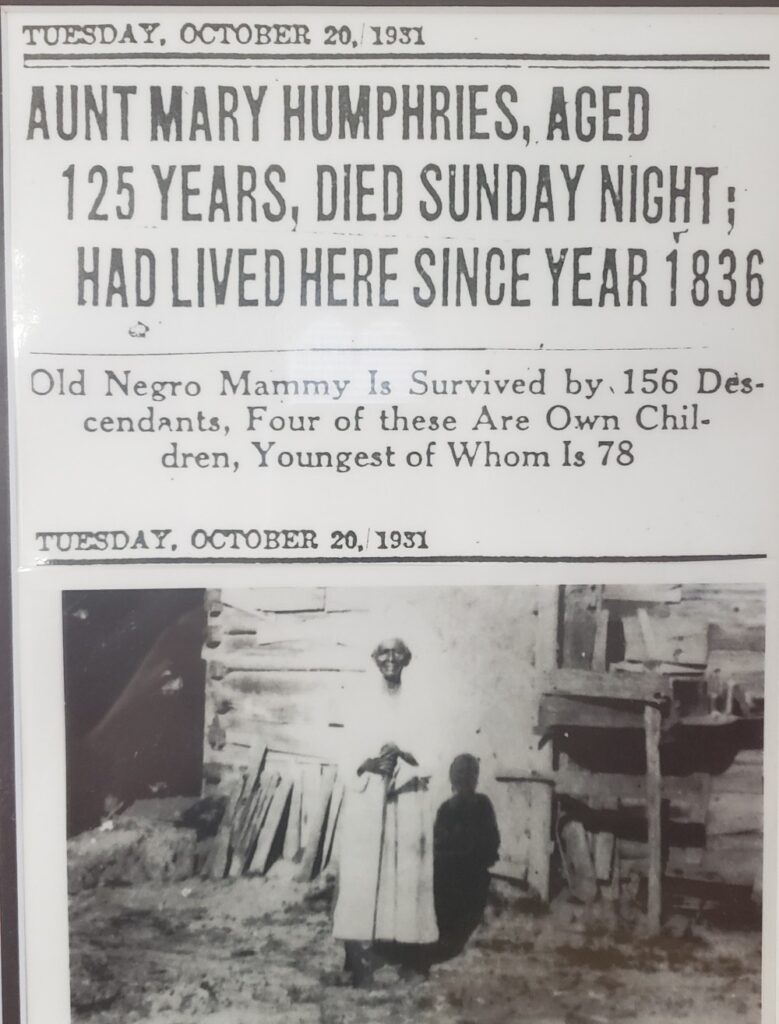
Photo Credit: Billy Don Montgomery.
“Back to a time when a memory of a man runneth not to the contrary… such a statement can be made with almost certainty when referring to the life of Old Aunt Mary Humphries, who died at her home in the Dirgin community Sunday night.”
That was the lead paragraph in an article from the October 20, 1931, edition of the Henderson Daily News, which told about the death of an “old Negro Mammy” who lived to be 125 years old with 156 surviving family members.
Seventy years after her death, there are still a number of families, the Pollards, Montgomerys, Humphries, Barns, Reeses, Mapps, and Menefees, living in Rusk County who are descendants of a woman who spent 60 years as a free woman.
The Dirgin community is located on Farm-to- Market Road 2658, one mile south of Texas Highway 4.3 and about five miles from Tatum.
Billy Don Montgomery, one of Aunt Mary’s great-great-grandsons, recently found the article on microfilm at the Rusk County Library and wanted to share her story with a new generation of Rusk Countians.
He explained that he first learned of the article when he found it in an old trunk of his mother’s after she passed away. However, it was not readable. Montgomery said one of Aunt Mary’s sons was a photographer in the ‘20’s and had taken a picture of the article when it ran in the paper.
About a year ago, Montgomery’s curiosity about the article led him to the Rusk County Library, where he was able to find it on microfilm, copied it, had it enlarged, and finally sat down and read about his family’s heritage.
He learned that Aunt Mary was born in 1805 near Memphis, Tenn., to a slave owner named Ware, “and when she was almost grown, her master had financial difficulties and his property was sold at a sheriff’s sale.”
During the sale, she, along with a cousin, was sold to a man by the name of Trammel, who “soon migrated to Alabama and with them, of course, went Mary Ware.”
From Alabama, she moved with the Trammel family to Texas in 1836 as part of an ox wagon train, and with her came many stories of the long, tedious journey across several states to the vast wilderness that Texas once was.
In conjunction with Black History Month, Montgomery, who is originally from Tatum but currently lives in Dallas, decided to share this unique story with the younger. generations so that they might have a first- hand account of what life was like for the slaves. Also, he feels very fortunate as an African American to be able to trace his family history back to the years prior to the Civil War.
The Article explained how Aunt Mary relayed, through stories, just how hard and trying the early days were, and how there “wasn’t much inducement for one to live except to serve her master.”
Although the year is unknown, Aunt Mary married Peter Humphries and had six children. At her death in 1931, the youngest of the six was 78 years old, and four were still living. Akk were born into slavery.
When slavery was abolished in 1865, and word finally reached Texas, Aunt Mary had become so much a part of her white master’s family that she refused to leave. According to the article,.” It was then that she was told to go to the saw mill and get lumber to build her a house where she could live in peace the rest of her days.”
While reading the article, Montgomery learned that his great-great-grandmother had worked her whole life – that it was the only thing she knew.
“As some of the white folks said of her, she did but two things: one was work and the other serve her God. She was very religious, as was attested by the faith she expressed way back before the Civil War when she was responsible for the establishment of the first Negro church so far as is known in this section of the state,” he read.
Surviving Aunt Mary were four of her six children, 31 grandchildren, 87 great-great-grandchildren, 34 great-great-grandchildren, for a total of 156. By 1931, the entire family line had numbered 167 descendants, 11 of which she outlived.
Her mind remained clear until a short while before her death, allowing her to tell of incidents all through her life in the later years as well as in earlier years.
She could remember Henderson before it was a town – when there was no church, no school, no courthouse. She was alive when A.J. Smith gave the land on which the town is built, and she recalled the building of the first courthouse following the organization of the county.
The article ended in this manner:
“A good old Black Mammy is dead, that she had lived out her life none can dispute, that she was ready to go was evident by the smile on her face Sunday evening when she asked for the old Negro hymn; but with all that was sadness, not only within the ranks of her own Black connection but hundreds of white folks wh had known and loved old Aunt Mary could but shed a tear of heartache tinged though it was with a gladness and assurance that Aunt Mary was at peace now. No more slavery and hardship for this old saint of her race. The last chapter is written in that life on the grave of whom can be written this most unusual statement – 1805-1931.”


